

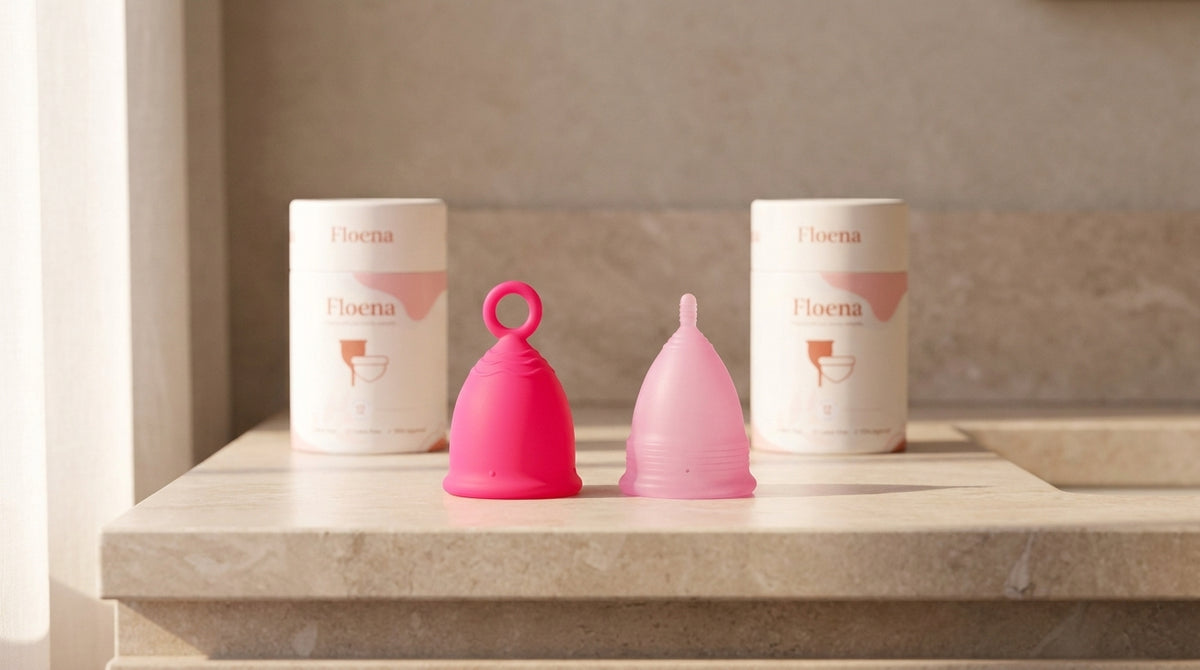
A menstrual cup ring is usually easier to locate and grip, while a stem is slimmer and gives more control over how much material sits below the cup. Neither should be used to pull out a sealed cup. In 2026, the safest removal rule is simple: pinch the base first to break the seal, then guide the cup out slowly.
Quick answer: Choose a ring if reaching and gripping the base makes you nervous. Choose a stem if you already remove cups comfortably and prefer a lower-profile base. The handle changes access, not the cup’s seal or capacity.
If removal is the part that puts you off reusable period care, start with the design rather than forcing yourself to adapt to the wrong handle. The Floena Ring Cup uses a soft ergonomic ring beneath a flexible cup body, giving your fingers a clear point to find without turning the ring into a pull cord.
Menstrual cup ring vs stem: the differences at a glance
| Feature | Ring handle | Stem handle |
|---|---|---|
| Finding the base | Clear loop for a fingertip | Narrow tab to locate and follow upward |
| Grip with wet fingers | More surface to hook or hold | Less surface; grip depends on texture and length |
| Removal | Guides the cup after the seal is broken | Helps locate the base before pinching it |
| Profile | Wider shape below the cup | Slimmer shape below the cup |
| Best for | Beginners, short reach, slippery removal | Experienced users, low cervix, minimal handle preference |
| Main mistake | Pulling the ring before breaking the seal | Pulling the stem before breaking the seal |
The decisive difference is grip. A ring gives you a larger target. A stem gives you a smaller target and may feel less noticeable when the cup sits low. Your anatomy, cup position and removal confidence matter more than which design looks simpler in a product photo.
What a ring and a stem actually do
A ring and a stem are retrieval aids. They help you find the bottom of the cup and steady it while your fingers reach the base. They do not create the seal, break the seal or hold the cup in place.
The cup’s rim and body do the sealing work. Changing from a stem to a ring therefore does not automatically solve leaks. If your cup leaks, the more likely causes are incomplete opening, a poor size match, incorrect positioning or a cup that needs emptying. Browse the menstrual cups and discs collection by body shape and size, not handle alone.
What the ring does well
- Creates a clear loop that is easier to identify by touch.
- Gives a fingertip somewhere to rest while you bring the cup lower.
- Offers more grip when fingers or silicone are wet.
- Reduces the fear that the cup is impossible to reach.
The trade-off is a broader base. If your cervix sits low and the ring rests close to the vaginal opening, you may notice it more than a narrow stem. A correctly sized cup should feel comfortable; persistent pressure, rubbing or pain means the fit needs attention.
What the stem does well
- Provides a slim guide to the cup’s base.
- Takes up less width below the cup.
- Can suit users who already know how to pinch and remove a cup.
- Makes it easy to feel the cup’s orientation without adding a loop.
The trade-off is grip. A smooth or short stem can be harder to hold, especially during the first cycles. The standard Floena Menstrual Cup is the clearer choice when you want a conventional cup shape and do not need a ring to guide removal.
Which is easier to remove?
A ring is easier to grip; correct removal technique is equally important for both designs. Cleveland Clinic’s menstrual-cup guidance, accessed in September 2026, says to pinch the base and never remove a cup by pulling the stem alone. The same logic applies to a ring: break the seal before using the handle to guide the cup down.
- Wash your hands. Give yourself privacy and enough time.
- Relax your pelvic floor. Sit on the toilet, squat or place one foot on a stable surface.
- Bear down gently. This can bring the cup base within easier reach.
- Locate the base. Follow the ring or stem upward with your fingers.
- Pinch the base. Hold until you feel the seal release.
- Rock the cup out. Keep it upright and move slowly rather than pulling straight down.
If the cup does not move, stop pulling. Reposition your fingers, pinch higher on the base and wait for the seal to release. Pain is not a step you should push through.
Choose a ring cup if these situations sound familiar
You struggle to find the cup
A ring gives your fingertip an obvious shape to locate. That can reduce the panic that appears when a cup sits slightly higher than expected. A cup cannot travel beyond the vaginal canal, but anxiety can tighten the pelvic floor and make it harder to reach.
Your fingers slip during removal
Wet fingers have more material to hold with a loop than with a narrow stem. The loop is especially useful after you have already pinched the base and want to maintain control as the cup comes out.
You are trying a cup for the first time
The learning curve is real. A handle you can identify immediately removes one source of uncertainty. The full beginner’s guide to using a menstrual cup covers folding, insertion, opening, wear, removal and cleaning in order.
You want several size options with the same handle
The Floena Ring Cup comes in Mini, A and B variants. That lets you choose the cup body for your flow and fit while keeping the same ring-style retrieval point. In 2026, this is more useful than treating one ring cup as a universal shape.
Choose a stem cup if these situations sound familiar
You already remove cups confidently
If your fingers naturally reach the base and break the seal, a ring may not add much. A stem still gives you a guide without the wider loop.
Your cup sits low
A lower cup can make any handle more noticeable. A slim stem may feel less present than a ring, although the right cup length and position remain the real deciding factors.
You prefer the simplest exterior shape
Some people want as little material as possible below the cup. A stem answers that preference without changing how the cup collects flow.
Comfort depends on fit, not just the handle
A ring cup can still feel wrong if the body is too long, too firm or poorly positioned. A stem cup can feel effortless when the body matches you. Compare these factors before blaming the handle:
- Cervix height: a low cervix leaves less room for a long cup and handle.
- Cup firmness: a firmer rim often opens more readily; a softer body may feel gentler but require more careful placement.
- Flow: capacity determines how often you need to empty the cup.
- Pelvic-floor tension: tension can make insertion and removal harder.
- Reach and dexterity: your preferred grip matters more than a generic best-for-everyone label.
If the cup remains painful, repeatedly leaks or is consistently difficult to remove, stop using it and ask a qualified healthcare professional for personalised advice. A different size or shape may be a better match.
Common removal mistakes in 2026
Pulling before releasing the seal
This is the main mistake with both ring and stem cups. The handle is not a rip cord. Pinch the base first.
Gripping only the handle
Use the ring or stem to find and steady the cup. Move your fingers to the base before applying downward pressure.
Rushing when the cup sits high
Pause, breathe and bear down gently. Repeated hard pulling usually increases tension and makes access worse.
Assuming every problem is the handle
Leaks and pressure usually point to size, shape, opening or position. Handle design mainly changes how easily you locate and guide the cup.
Judging the cup after one attempt
Your first removal is not a final verdict. Practice when you are at home and not under time pressure. In 2026, the best cup is still the one you can insert, wear and remove calmly.
Ring cup or menstrual disc?
A ring cup still sits and seals like a menstrual cup. A menstrual disc sits higher and does not use the same cup-style suction seal. If your real question is about placement rather than handle design, read the menstrual cup vs menstrual disc comparison before choosing.
Choose a ring cup when you want cup-style placement with a clearer grip. Choose a disc when you want a different internal shape and placement altogether.
Frequently asked questions
Is a ring menstrual cup easier for beginners?
Yes, a ring can be easier for beginners to locate and grip. You must still pinch the cup base to release the seal before guiding it out.
Can I pull a menstrual cup out by the ring?
No. Use the ring to find or steady the cup, then pinch the base and break the seal. Pulling a sealed cup by its ring can cause discomfort.
Can I pull a menstrual cup out by the stem?
No. Cleveland Clinic’s current guidance says not to pull on the stem alone. Follow it to the base, pinch the base and remove the cup gently.
Does a ring make a menstrual cup leak?
No. The ring does not create the seal. Leaks are more closely linked to incomplete opening, position, size or a full cup.
Is a stem better for a low cervix?
A slim stem may feel less noticeable, but total cup length and body shape matter more. Choose a model sized for your anatomy and stop if it causes pressure or pain.
Can the ring or stem get lost inside me?
No. A menstrual cup stays within the vaginal canal. If it sits high, relax, bear down gently and reach for the base rather than pulling in panic.
Should I trim a menstrual cup stem?
Only follow the manufacturer’s instructions for that specific model. Never cut a handle while the cup is inside your body, and do not trim a ring unless the product explicitly permits it.
One last thing
The best handle is the one that helps you reach the base without tempting you to pull against the seal. For a first cup in 2026, a ring wins on grip. For an experienced user who wants a slimmer base, a stem remains the cleaner choice.
Editorial review: Reviewed by Mia Hartman on 2 September 2026 for clarity and product accuracy.
Source: Cleveland Clinic menstrual cup guidance, accessed 2 September 2026.


